Retrieval Augmented Generation Guide
Retrieval Augmented Generation: 7 Key Things You Need to Know in 2026
Retrieval augmented generation is one of the most important AI methods for building accurate, useful, and trustworthy language model systems. Instead of relying only on a model’s training data, retrieval augmented generation connects AI to external knowledge sources and helps it produce better answers.
This guide explains what retrieval augmented generation is, how it works, why it matters, its benefits, limitations, real-world use cases, and how creators, developers, and businesses can use it effectively.
Retrieval Augmented Generation Table of Contents
What is Retrieval Augmented Generation?
Retrieval augmented generation, often shortened to RAG, is an AI architecture that improves large language models by connecting them to external information. A normal language model answers from its training data. A retrieval augmented generation system first searches a knowledge source, retrieves useful information, adds that information into the prompt, and then generates a final answer.
This makes retrieval augmented generation extremely useful for tasks where accuracy matters. For example, a company can connect an AI assistant to internal documents, product manuals, customer support articles, or private databases. Instead of guessing, the AI can answer based on the retrieved material.
The main idea is simple: retrieval augmented generation gives AI a memory source outside its original training. That external source can be updated, edited, expanded, and controlled. This is why retrieval augmented generation is now one of the most popular methods for serious AI applications.
How Retrieval Augmented Generation Works
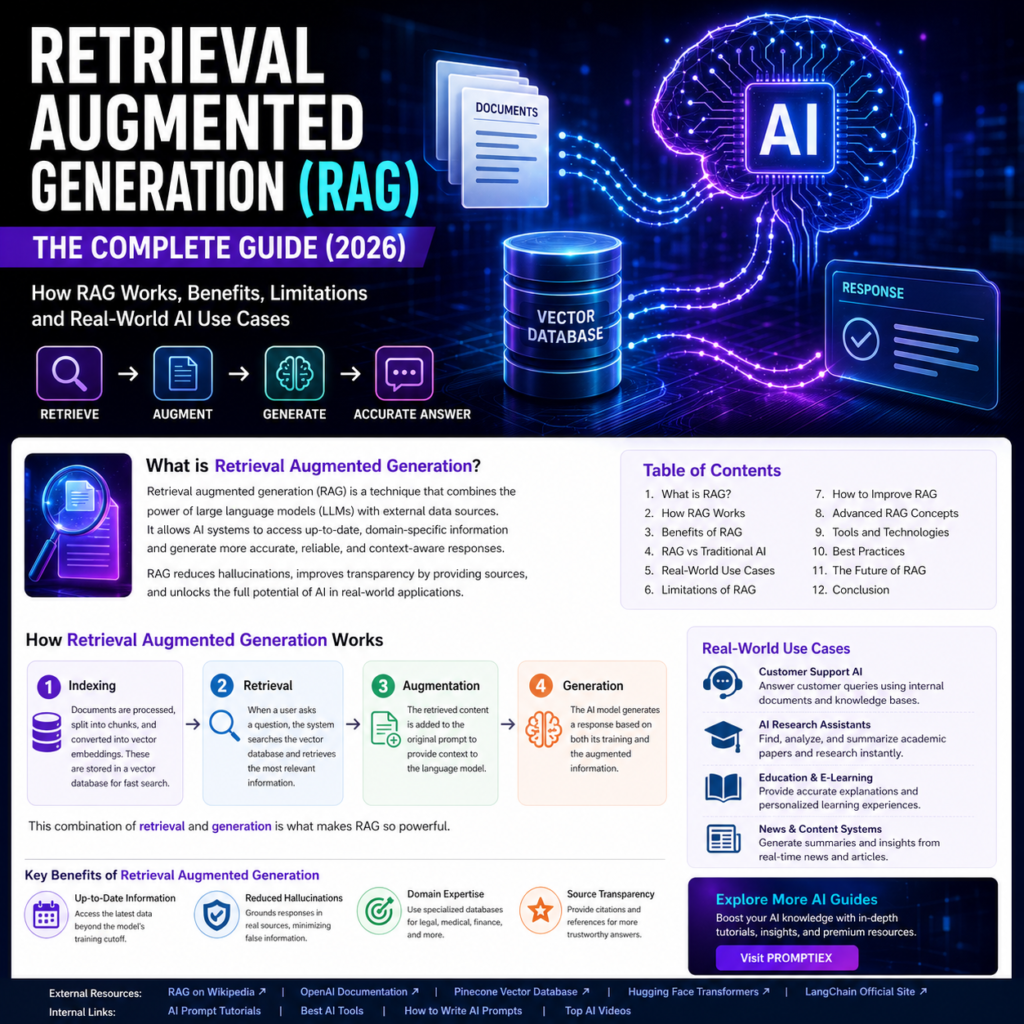
The retrieval augmented generation process usually includes four major steps: indexing, retrieval, augmentation, and generation.
Retrieval Augmented Generation Indexing
Documents are split into smaller chunks. These chunks are converted into embeddings and stored inside a vector database.
Retrieval Augmented Generation Search
When a user asks a question, the system searches the database and finds the most relevant chunks.
Retrieval Augmented Generation Augmentation
The retrieved information is added to the model’s prompt as supporting context.
Retrieval Augmented Generation Answer
The AI generates an answer using both the user question and the retrieved information.
This pipeline helps the model stay grounded. Instead of producing a response only from general training data, retrieval augmented generation gives the model specific context before it answers.
Benefits of Retrieval Augmented Generation
Retrieval Augmented Generation Improves Accuracy
Because the AI uses retrieved documents, answers can become more factual, detailed, and relevant. This is especially helpful for technical, legal, medical, educational, or business content.
Retrieval Augmented Generation Reduces Hallucinations
AI hallucination happens when a model invents information. Retrieval augmented generation reduces this risk by grounding responses in real data.
Retrieval Augmented Generation Supports Fresh Data
Training a new model is expensive. Updating a knowledge base is easier. This allows retrieval augmented generation systems to use newer information.
Retrieval Augmented Generation Adds Transparency
RAG systems can show references, links, or source snippets. This makes answers easier to verify and trust.
Limitations of Retrieval Augmented Generation
Retrieval augmented generation is powerful, but it is not magic. The quality of the answer depends heavily on the quality of the retrieved information. If the system retrieves the wrong document, the final answer can still be wrong.
Retrieval Augmented Generation Can Retrieve Wrong Context
Ambiguous words can confuse the system. For example, “Apple” can mean the fruit or the technology company. A weak retrieval system may bring irrelevant results.
Retrieval Augmented Generation Can Be Slower
A normal model can answer immediately. A retrieval augmented generation system has extra steps: search, ranking, context building, and response generation. This can increase latency.
Retrieval Augmented Generation Still Needs Good Prompting
The retrieved content must be inserted into the prompt clearly. Bad prompt structure can cause the model to ignore useful information or over-focus on weak context.
Real-World Use Cases of Retrieval Augmented Generation
Retrieval augmented generation is used in many modern AI systems. Customer support bots can answer from help center articles. Research assistants can summarize papers. Enterprise AI tools can search internal documents. Education platforms can provide accurate explanations using approved learning materials.
For content creators, retrieval augmented generation can also support SEO research, prompt libraries, AI tutorials, and trend tracking. A site like Promptiex can use retrieval augmented generation concepts to organize AI prompt tutorials, tool guides, and prompt examples in a more useful way.
Retrieval Augmented Generation Best Practices
To get the best results from retrieval augmented generation, start with clean data. Remove outdated, duplicate, weak, or misleading content. Then split documents into meaningful chunks. If chunks are too large, retrieval becomes messy. If chunks are too small, the model may lose context.
Use semantic search, keyword search, or hybrid search depending on your project. For important systems, use re-ranking to sort retrieved results by relevance. Always test the system with real user questions.
Good retrieval augmented generation also needs strong UX. Users should know when an answer is based on documents, which sources were used, and whether the answer may be incomplete.
The Future of Retrieval Augmented Generation
Retrieval augmented generation will become even more important as AI systems move from simple chatbots to advanced AI agents. Future systems will combine retrieval, reasoning, memory, tools, and automation.
The best AI products will not only generate text. They will search, verify, compare, cite, summarize, and act. Retrieval augmented generation is one of the foundations of that future.
Retrieval Augmented Generation Conclusion
Retrieval augmented generation turns AI from a static answer generator into a knowledge-connected system. It improves accuracy, supports fresh information, reduces hallucinations, and makes AI answers more useful for real-world tasks.
If you are building AI tools, writing AI content, creating tutorials, or developing a knowledge-based assistant, retrieval augmented generation is one of the most important concepts to understand in 2026.